
REVIEW: Misery Signals - Ultraviolet [2020]
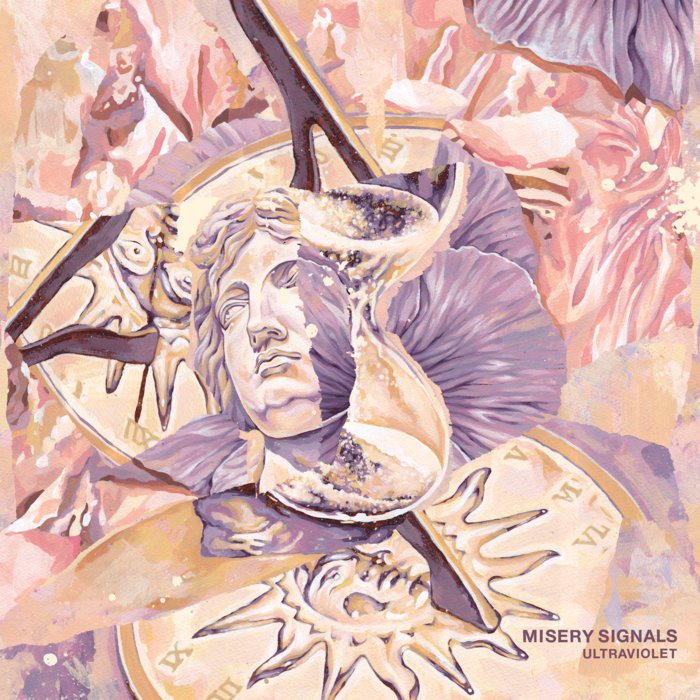

Artist: Misery Signals
Album: Ultraviolet
Everything exists in a spectrum—there are really precious few (if no) absolutes. Everything, from our favorite foods, types of people, hell, even the colors and wavelengths in which we see, exists on a spectrum. Heavy music is no different, with countless varieties and variations out there—hell, probably even more than I know, but within metalcore at least, they all share a common thread: they were all probably influence by Misery Signals to some degree. Erupting out of nowhere in 2002, the awe-inspiring fashion in which the band have fused groove metal, metalcore, hardcore and elements of various metallic subgenres has provided a path—a foundation, even—for bands operating in the same vein. Hell, even bands with members who might not have even listened to Of Malice and the Magnum Heart or Controller are likely influenced by it to some degree. When rumor first surfaced of their reunion in the early months of 2016, the internet was abuzz with excitement—now, nearly four years, a pandemic and a global shutdown later, Misery Signals’ long-awaited comeback release is upon us. Ultraviolet is the band spanning their own spectrum—touching on their most overt melodic influences in the same breath as they touch on their most ruthless and aggressive ones. The real question, however, remains: do Misery Signals still have the same appeal and energy that defined their immensely influential sound all those years ago? Ultravioletsees Misery Signals creating something that is quintessentially them.In a statement made in November of 2010, guitarist and founding member RyanMorgan said “If the time came that our sound took a drastically differentcourse, then it wouldn’t be Misery Signals, and we wouldn’t pretend that itwas.” Although that statement prefaced the release of Absent Light, thatsame thought process holds true with Ultraviolet. Songs like “River King”and “Through Vales of Blue Fire” see the band churning out aggressive, punchycuts with percussionist Branden Morgan hammering out massive drum patterns thatsmoothly transition between groove and gut-busting breakdowns without stutteror faulter. Other songs, especially album closer “Some Dreams” see Morgan’sdrumming serving as a more mellow foundation for Kyle Johnson’s dense bass, andfor the dynamic efforts of guitarists Ryan Morgan and Stu Ross. Where Morgan’spercussion is punchy, the fretwork is ruthless and distinctly metallic—see “RiverKing,” or lead single “The Tempest.” Here, Morgan (Ryan Morgan, that is) andRoss are riveting, creating mesmerizing leads that segue into spine-splinteringbreakdowns. Elsewhere—“Some Dreams” and “Cascade Locks”—the duo craftatmospheric metalcore cuts that send the listener sprawling into a relativedream sequence, contrasting distant, ethereal leads against bass-heavy groovesthat rock the listener just harshly enough to keep them tethered in reality,but envelop them just enough to lull them into a serene state of mind. Ultravioletis home to a truly remarkable amount of diversity—all without Misery Signals sacrificingcore elements of what has made them a powerhouse (and, indeed, an bastion ofinfluence) within the genre.
Where AbsentLight saw the final contribution to Misery Signals from former frontmanKarl Schubach, Ultraviolet sees Jesse Zaraska return to the fold—and whata return it is. Zaraska is vicious, with his screams blending riveting, soulfulemotion into the mix with raw, primal aggression. “River King” sees him at hismost catchy—with his candor and patterning playing in perfectly alongside theband’s bouncy-yet-heavy instrumentation. Meanwhile, the closing numbers see Zaraskaincorporating less variety but more emotive power into his syllables, with theclosing segment of “Some Dreams” hitting the listener squarely in the heart. WhileZaraska may not be the most diverse vocalist out there—with much of his work onUltraviolet living comfortably within the mid-range, barring fewexceptions (notably, “The Tempest” and “Old Ghosts”). Where this might appealless to those who have only discovered heavy music in the last couple years, itlargely plays to Misery Signals’ strengths—as a band who don’t needoverwhelming technicality, vocal variety and gimmicky techniques to impartoverwhelming emotion and intensity with a masterful use of raw, unfiltered andun-fucked-with metalcore. Zaraska fits that bill just fine, capturing many ofthe same feelings as he did on Of Malice and the Magnum Heart, but in a morecontemporary frame.
Really, thatmight be the best way to describe Ultraviolet. It isn’t a re-make of Malice,nor does it really strive to be a song-for-song counterpart thereof. Instead,it feels like what Of Malice and Magnum Heart—or even Controller,to a lesser point—might feel like if they were recorded and released in 2020.While it is brief—especially considering it’s the band’s first offering in sevenyears—it is a powerful and dense listen, with songs that manage to be catchy,crushing, beautiful and bold all in under four minutes (and all without beingoverbearing or forced). While prospectively, old heads might be skeptical ofthe band’s resurgence, and newer initiates into heavy music might not get the hype,once heard, Ultraviolet is a record that truly touches on every wavelengthin heavy music’s essential spectrum.
9/10
For Fans Of: Shai Hulud, Comeback Kid, A Plea for Purging,Counterparts
By: Connor Welsh