
REVIEW: A Night in Texas - The Darkest side of Humanity [2026]
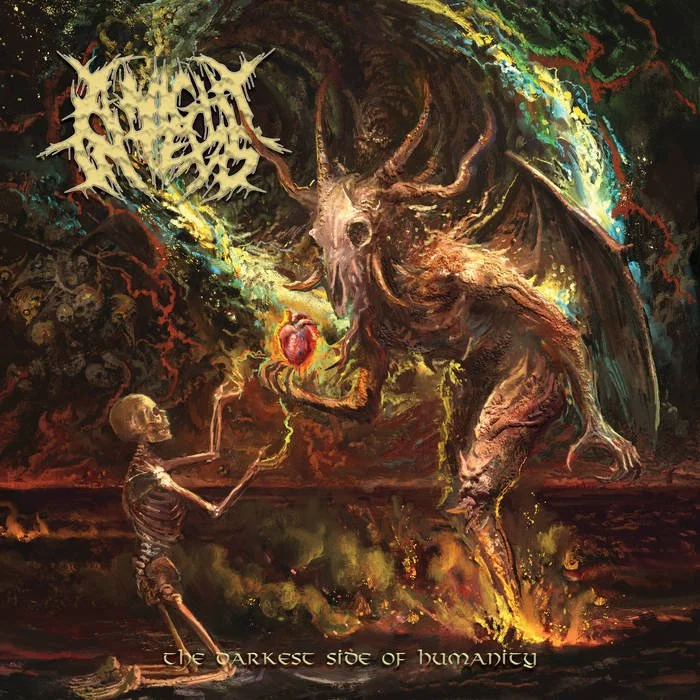
Artist: A Night in Texas
Album: The Darkest Side of Humanity
Without beating around the bush or pontificating superfluously, The Darkest Side of Humanity is nothing if not an incredibly timely record with respect to its name. Every day, things seem worse—the news stories grow more bleak and apocalyptic scenarios feel less like impossibilities and more like wishful thinking. In the same vein, the 2026 LP from A Night in Texas and the follow up to Digital Apocalypse expertly channels bleak, dismal anguish into lacerating, technical the pummeling deathcore. Crafted on a firmament of break-neck percussion and humbling intricacy, The Darkest Side of Humanity sees the Australian deathcore juggernaut refine the successes of Digital Apocalypse while avoiding many of the record’s missteps—but as the latest entry in a long and vicissitudinary discography, where does it land among the band’s ups and downs?
Those who have followed A Night in Texas’ career since Invigoration or The God Delusion are no doubt accustomed to their instrumental stylings: blisteringly fast and immolating in their intensity. The Darkest Side of Humanity is no different—at least for the majority of its runtime. Songs like “Metastatic Misery” and “Rot from Within” hinge on mach-speed drumming and frantic riffing, highlighting the Promethean nature of the band’s drumming and composition. “Fed to Death” is another cut that practically waterboards the listener without outright speed and voracity with a crass juxtaposition of mind-melting speed and bone-busting, garish brutality. “The Infinite Maw” is another song that works tirelessly to blend segments of surreal speed into portions of pummeling and outright heaviness, using explosive breakdowns to punctuate languishing segments driven by mile-per-minute blast beats and dizzying fretwork. Other songs—like segments of the album’s title track, and the sonic intermission “When the Sun Burns Out” see A Night in Texas embracing ethereality and atmosphere more than they have previously, channeling more robust and melodramatic crescendos of post-metal infused deathcore a la Fit for an Autopsy. While these segments serve well to break up the onslaught that is The Darkest Side of Humanity, they also overstay their welcome slightly—especially on “When the Sun Burns Out,” a song that strays dangerously close to monotony. What’s more is that on more than one occasion, the often-tasteful use of sparse backing samples and subtle symphonic elements becomes a little more than sparse, and detracts from the otherwise dense and technically immaculate instrumental onslaught the band bring to the table. While those brief flashes of horns and strings fit excellently on cuts like “Oblivion’s Dominion” and “A Primal Conditioning,” they feel a little too overbearing on otherwise sound songs like “Fed to Death.”
Just as the band’s instrumental efforts are gargantuan, so to are their vocal elements. Harshly spat, visceral shrieks serve as the mainstay throughout The Darkest Side of Humanity, though the variation between shrill screams, raw mid range yells and gurgling low bellows is enough to satiate just about any fan of extreme metal. This variety is aided by the sparse-but-impactful guest appearances throughout The Darkest Side of Humanity—especially a guest appearance by Rheese Peters, one of the band’s former vocalists. While much of the vocal work on The Darkest Side of Humanity is strong, it isn’t without room for critique. Some songs—“Fed to Death” and “The Infinite Maw” in particular—overstep the boundary from engaging vocal diversity into pure vocal masturbation. In the opposite direction, “When the Sun Burns Out” is home to its fair share of singing, and while I’m far from getting on a “singing is bad” soapbox, it does feel a little out of place in the context of an otherwise hyperspeed slab of technical deathcore. For some, this is welcome—but for others, it feels like a slight detraction from the otherwise tasteful employ of several different vocal styles and ranges to create an otherwise fluid and engaging listening experience.
The Darkest Side of Humanity is a strong record—frankly, stronger than several of A Night in Texas’ previous full length releases and likely their most well-rounded since at least Global Slaughter if not The God Delusion. In spite of this, some elements seem to blur the line between tasteful and out of place, be it the occasional overuse of background samples, segments fit for submission into the YouTube Vocal Olympics or perhaps slowing things down a touch too much. These don’t make The Darkest Side of Humanity a bad record by any means—just give A Night in Texas a little more room to continue to refine their sound and style.
7/10
For Fans Of: Nexilva, Shadow of Intent, Crown Magnetar, Lorna Shore
By: Connor Welsh